Build log · 2026.07.26
I started building a robot a while back, but today I started writing about it
Why I'm building a robot: the motivation, the concept sketch, and the platform I landed on.
It’s actually the whole reason I made this site.
It’s 2026, and there are some not-so-great things happening. However we’re living in something of a golden age if you want to build your own robot.
My motivation had a few angles to it. First, I miss working on robot hardware. Since finishing my degree and moving into a customer-facing role at an ML software company, I haven’t been nearly as hands-on, and I’ll tell ya, I miss it. Second, I need a platform to record realistic robot data so I can better work with the new multimodality and robotics features in FiftyOne. But most importantly, I have an idea for a new robot platform. It seems really cool in my head, so now feels like the time to build it. Agentic development clears backlog like no other.
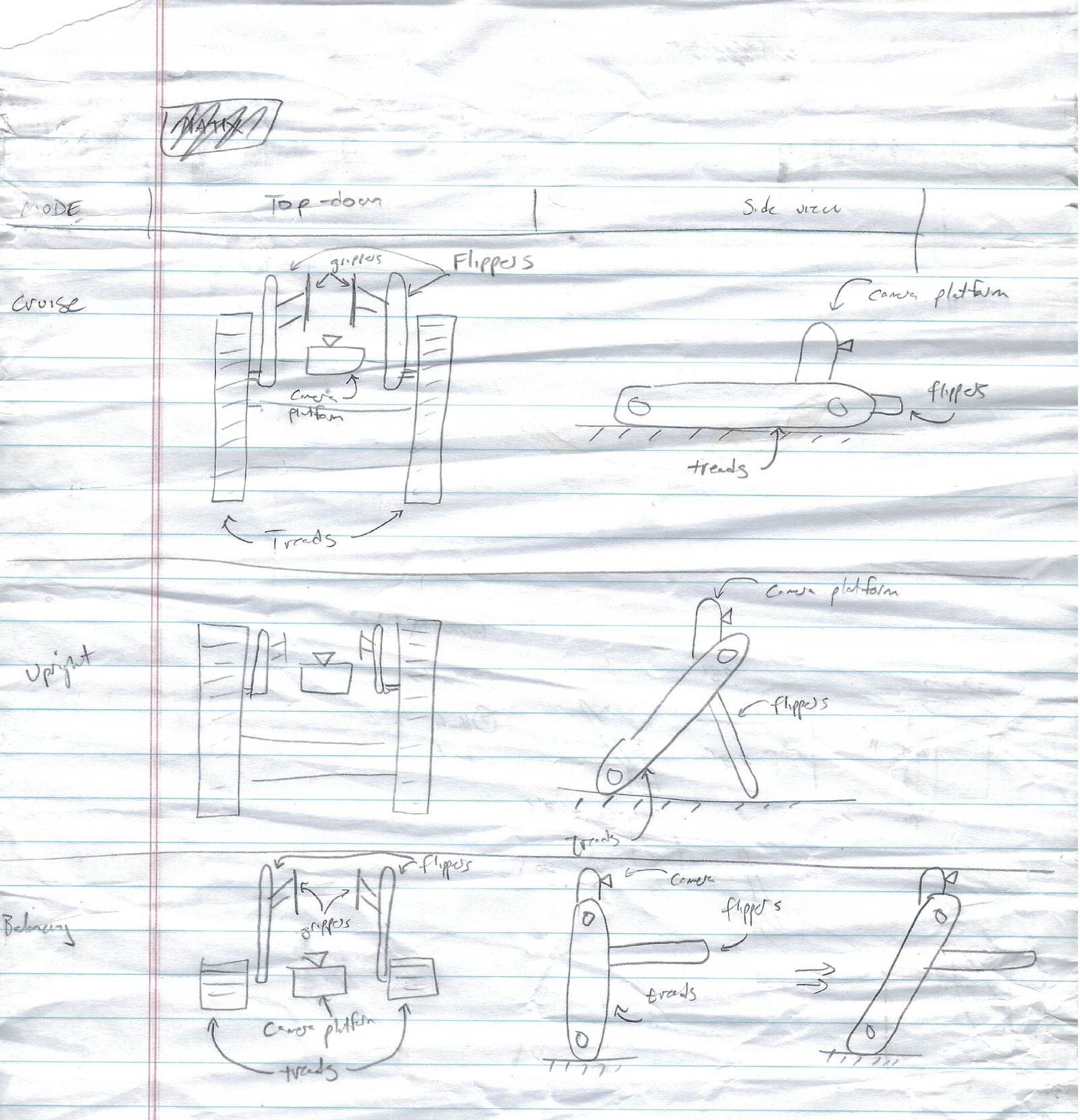
I started by sketching out the concept. I wanted a robot that:
- Can crawl flat or balance upright. I’ve never built an inverted pendulum control system before (nerdspeak for self-balancing, like a Segway).
- Can climb and descend stairs. This thing needs to get around my house, and anyone’s house.
On the functional side, it should also be a proper ROS2 platform:
- A sensor suite capable of running a navigation and perception stack
- Data recording for offline development
Really, the goal is to have some fun while building a surrogate platform for some of my research into perception, sensor fusion, and world modeling.
I landed on something that will really test the bounds of my current capabilities: differential drive with two long treads on the sides, plus two flipper arms that extend the chassis for stair climb and descent while also letting the robot stand upright. A camera and an IMU make up the sensor suite. I want to keep weight and size down (light enough to fit in a backpack) so it gets a Jetson Orin Nano. The whole thing is actuated by gearmotors with integrated encoders and standard hobby servos.
As for a name, I’m calling it R-1. That’s partly because I’m used to the military calling everything by a letter and a number: the H-60 Helicopter, the F-15 Fighter, the C-130 Cargo plane, the M-1 tank. It’s going to be small (payload on the order of 1 kg), and it’s my first robot design from scratch, so R-1 is my internal designator.
The problem is that there are already a few R-1 robots out there (most notably from Unitree), so I’m going with the more personable “Arwun”. Do you remember how R2-D2 got called “Artoo”?
I actually started a few weeks ago; this is just the first post on the topic. A lot of the decisions above came out of preliminary analysis in Drake, benchtop testing, and reading up on things like the average rise and run of stairs in the US. But I had to start somewhere, so here we are.
I’m working on a few aspects of the build simultaneously and will post here as time allows. The initial analysis, benchtop testing, and Orin Nano setup are all done so look for posts on those processes next.